Thank You

Posted at the campaign website:

The recount is over, and we came up short by just 12 votes out of over 56,000 cast. I am unbelievably proud of the campaign we ran. We built thoughtful, progressive policy proposals that sparked conversations across the district. We discussed those plans together on 31,543 doorsteps over eight months. And we inspired 11,287 voters to take a stand for the public schools our children deserve.

While it’s tough to lose so narrowly, the truth is that candidates like me – a young, middle-class, public school teacher and immigrant son with a funny name – aren’t supposed to come this close when running in a race like this. And in the end, we have a team of outstanding advocates for transit, women and families, and civil liberties representing us in Annapolis. Congratulations to Marc, Ariana, and Sara and to fellow candidates Marc, Joe, Nuchhi, and Jordan on a great campaign.

It’s actually hard to call this a loss. As we awaited results on election night, I looked around the room and was stunned by how young the room was. Outside of friends and fellow teachers, this campaign was was powered by high-school and college students, most of whom were working their first campaign. I can guarantee that a bunch of them are going to run for office themselves someday. I just hope it’s sooner rather than later. (Standing offer: I will come knock on doors for any of you when you decide to take the plunge.)

“Mr. Paul goes to Annapolis” would have been a satisfying civics lesson for my students, but “Mr. Paul showed me how to fight for what I believe in” is a pretty good second choice. To all of those young people: please please please continue to assert yourselves in our public life. You are light years ahead of where I was at your age, and if I could make your votes count double, I would. Thank you for blessing me with the gift of your time and trust and sweat and belief. When young people learn how to take a stand, how to be part of a community, and how to fight for the future they’ll someday inherit, we all win.

For every old friend who wrote a check, for every new friend who hosted a meet-and-greet, for every young person who knocked on doors — it’s impossible to overstate the gratitude I feel in my heart right now. I have spent almost a year asking everyone I know to help me in some way or another, and it’s been amazing to see people answer the call even right up until the very end. And, of course, I am deeply grateful to my parents, who left everything and everyone they knew to come to a country where this kind of thing is even conceivable within one generation.

It was incredibly difficult to run this campaign while teaching, and I am more tired than I’ve ever been in my life, including my first year in the classroom. So I’m going to take a break for a little while and reflect on what exactly the next phase of my advocacy should look like. But Maryland STILL has a once-in-a-generation overhaul of our school funding next year; young people are STILL being gunned down in our schools and on our streets; climate change STILL hangs over us like a guillotine; immigrant families STILL struggle to survive and to see themselves reflected in public leadership; and our economy is STILL oriented toward the past rather than my students’ future. So even though I won’t be the one casting votes in the House of Delegates next session, there’s plenty of work for all of us if we want to make this place more just, inclusive, and abundant.

I don’t know where this train stops next, but I will forever be grateful for the ride we’ve been on together.

#PaulAboard,

Samir

What Happens When You Flip Your Classroom?

My state teachers’ union asked me to reflect on my experience flipping my classroom. Here’s what I wrote to explain both what I love about it and what it can never replace.  Choice snippets up front, and then the whole thing after the jump.

Flipped classrooms give students control over their own pace of consumption. They can watch me at regular speed or at 2x or, if they’re already confident about this topic, they can roll the dice and skip a lecture at their own risk. They can rewind, re-watch, and skip ahead as they’d like. Students don’t have to feel self-conscious about consuming new material slowly, nor do they have to feel the boredom of waiting for the rest of the class to catch up when they are ready to press on. And because students submit initial questions asynchronously, I can elevate the voices and insightful contributions of girls who — for whatever reason — might not otherwise have spoken up in a live-fire STEM classroom setting.

Learning is a fundamentally social activity. For thousands of years, young people have learned with others, and I blanch at “innovations” that shake this basic fact about the way kids develop. There is something special about experiencing a new idea for the first time with a room full of other people — something electric that is hard to capture if everyone has already seen the big idea independently and you’re just fine-tuning it as a group.
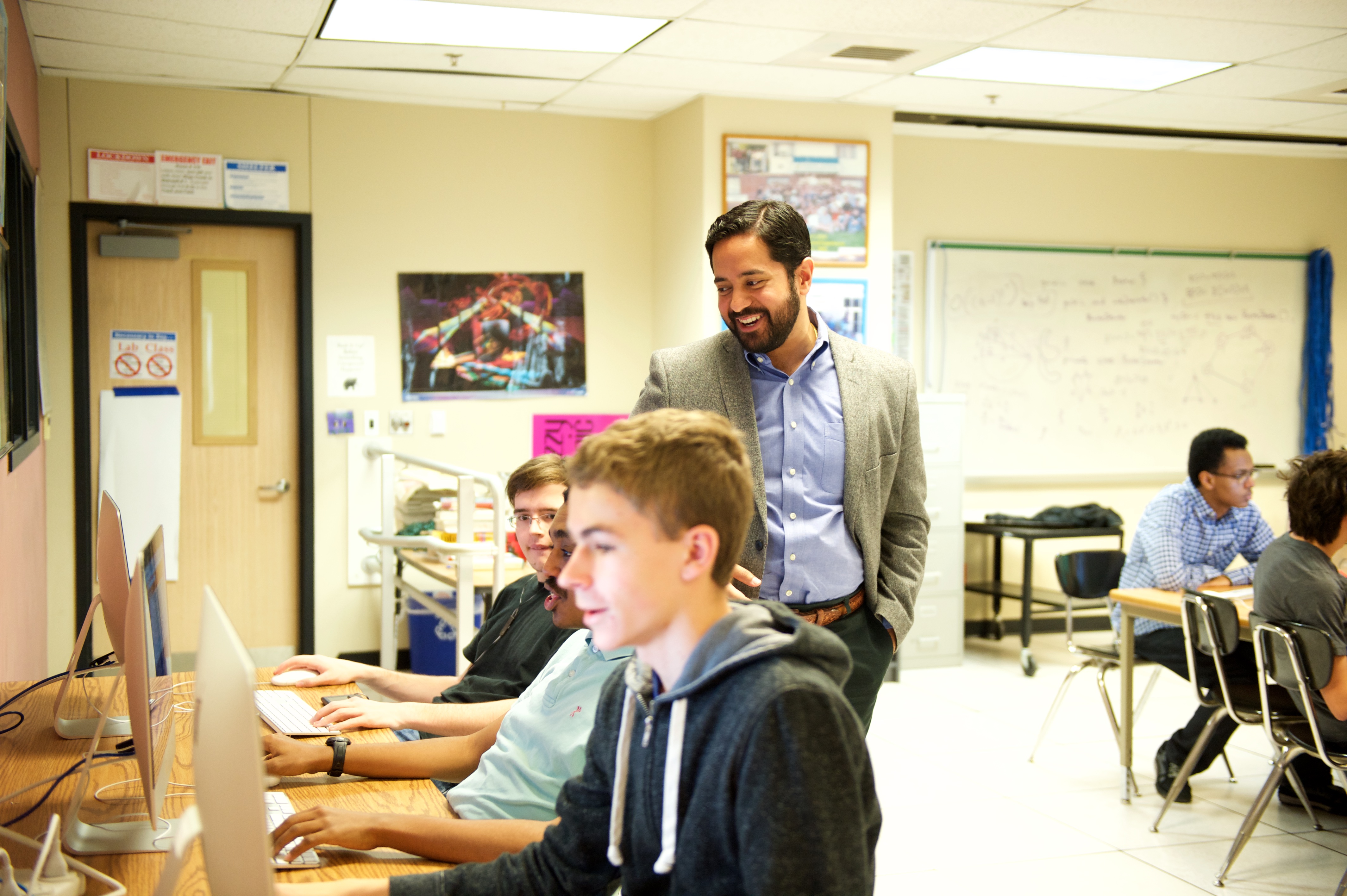

Sometimes, during work time, I used to interpret pin-drop silence and 100% engagement in my classroom as the sign that I had done something right and had designed an activity that gave every student an entry point and a path forward regardless of her/his level of prior knowledge.

Now, that mostly makes me nervous. Why isn’t anyone talking about anything? Why isn’t anyone laughing? Why isn’t anyone asking anyone else for help? I’ve played a lot with the flipped classroom structure over the past few years and it has yielded plenty of impressive benefits. But it can never replace the special magic that a skilled teacher can conjure at the whiteboard, pin-pricking students’ brains for the first time with a brand new idea.

Read more

2016 Rising Star Teacher of the Year

paulwithstudents

via MCPS:

Two teachers have been named Rising Star Teachers of the Year by the Marian Greenblatt Education Fund. This award honors teachers with less than five years of experience whose creativity and enthusiasm encourages students to stretch themselves and achieve more.

This year’s recipients are Samir Paul, computer science teacher at Montgomery Blair High School, and Kaila Wiggins, first grade teacher at Clopper Mill Elementary School.

Paul, a 2006 alumnus of the Math, Science and Computer Science Magnet Program at Blair, is in his fourth year of teaching and his second year teaching computer science at his alma mater. In the three courses he has taught—Computer Programming 1, Algorithms & Data Structures and Advanced Placement (AP) Computer Science—he has gone beyond the resources provided to him and created project-based learning opportunities for students to code and to discover the power of computer science. He has a unique classroom management style which has proven effective—his students watch his prepared lectures at home and he spends his classroom time working on college-level problem sets. He has also added a plethora of programming experiences to his Algorithms & Data Structures course, including encryption, steganography, credit card validation techniques and DNA data extraction.

After Paul’s first year of teaching, Blair saw an immediate impact on student assessment data. The school’s AP computer science scores reached a five-year high. In 2004, Blair’s computer science students scored an average of 4.4 with 55 percent receiving the highest score of 5. In 2015, nearly 100 students scored an average of 4.8 with 84 percent receiving a top score of 5.

He holds a bachelor’s degree from Harvard University and a master’s from American University. He is the vice president of the school’s PTA, a position that had never previously been held by a teacher. He worked to modernize the website and developed a parent outreach database. He is also a member of the board of directors for the Blair Magnet Foundation and represented Blair at a White House Summit on computer science education.